Editor
Canvas & tools
The editor is where a book comes together. You can generate more pages, insert puzzles, tweak each image, set print options for KDP, and reorder the whole book — all in one screen. Everything auto-saves; there is no explicit save button.
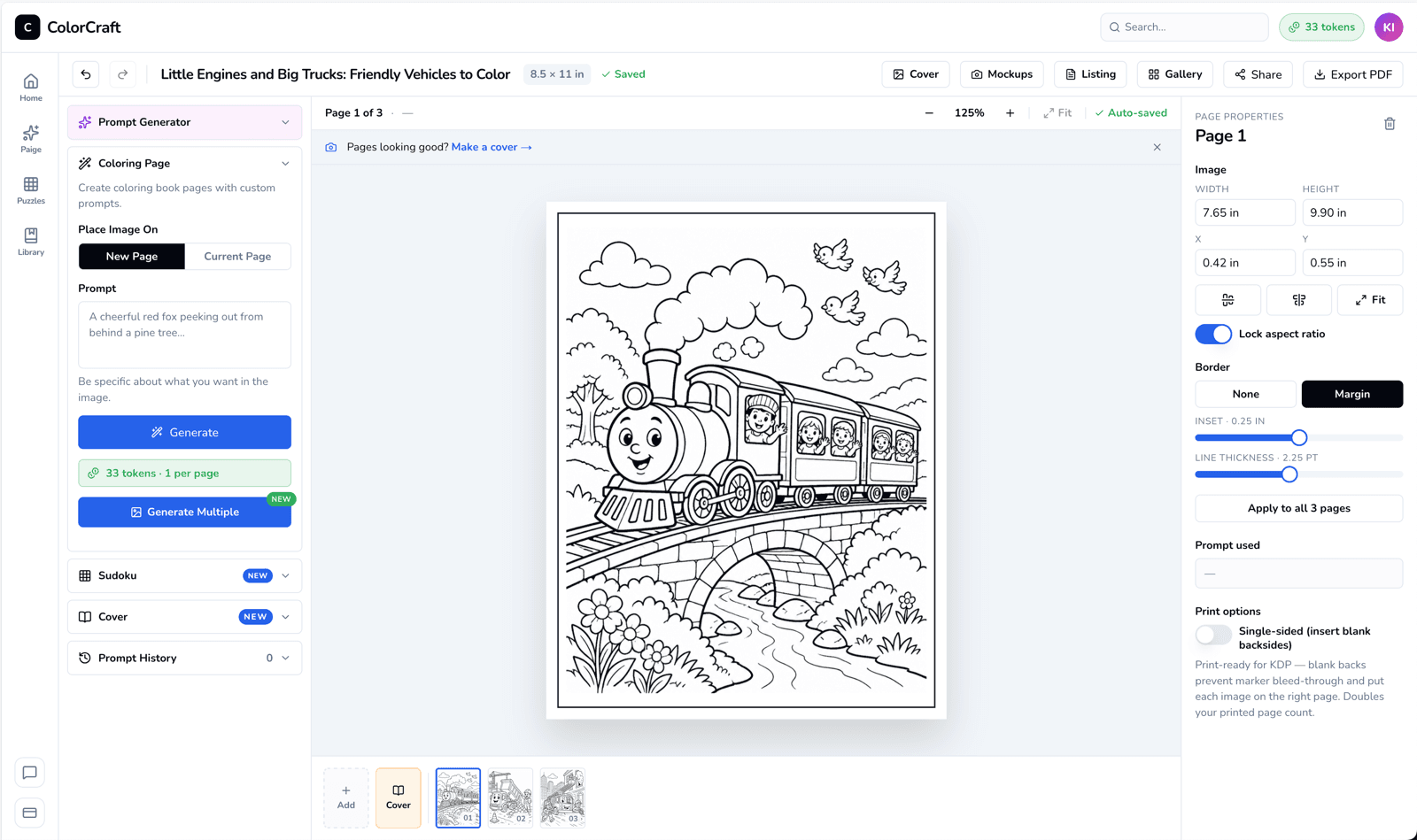
Top bar
Project title, save status (“Saving…” / “Saved”), the current page indicator (Page N of M) with a short prompt excerpt, undo/redo, zoom controls, and Export. The save status is authoritative — when it says Saved, closing the tab is safe.
Left sidebar — generation
The left side is an accordion of everything you can add to the project. Click any panel header to expand it; only one panel is open at a time.
Paige generator
Give Paige a theme and a page count (1–25 per batch); she drafts a prompt per page and renders the batch in the background — up to 10 pages generate concurrently. Pages are appended to the project you have open.
Same engine as the Paige wizard, different scope. See Three ways to start for the comparison.

Coloring page (per-page generator)
The one-at-a-time primitive that every path in ColorCraft ultimately calls. Two modes:
- New page — render a prompt and append the result as a new page.
- Current page — render a prompt and overwrite the image on the page you have open. If a rendered image already exists, you’ll get a confirm dialog first.
1 token per generation, deducted from your monthly balance.

Puzzle insertion
You can drop puzzles into the middle of a coloring book — sudoku, mazes, word-search, crossword, cryptogram. Each puzzle type gets its own accordion panel with its own config (difficulty, grid size, word bank, etc.). Puzzles generate in chunks so a 50-puzzle batch doesn’t block the tab.
Sudoku panels have a Solutions per printed page control (1, 4, or 9) — how many solutions to pack onto the back-of-book answer pages. This persists per project.
Details per puzzle type: Sudoku, Mazes, Word search, Crosswords, Cryptograms.
Storybook page
Only visible on storybook projects. Insert a single narrated scene with a description, location, and time-of-day. 1 token per rendered scene. See Paige for storybooks.
Cover
Jumps out of the editor into the dedicated cover generator— front, back, and spine sized to the KDP trim you picked.
Prompt history
The last 20 prompts used in this project. Click any entry to re-use the prompt — useful for keeping style consistent when you add more pages later.
Right sidebar — page inspector
The right side is context-aware: it shows properties for whatever you’ve selected. Panels shown here are the defaults for a coloring-book page with the base image selected.
Page N — delete
The page identifier at the top, plus a Delete page button. Delete is a hard remove — the page is gone from the project. It’s disabled when the project only has one page left. No tokens are refunded (the render cost is already spent; the image itself stays in your My Pages library).
Image — dimensions & centering
Width and height in inches, X/Y position, and a lock-aspect toggle. Three quick actions:
- Center horizontally — snap to the page’s vertical midline.
- Center vertically — snap to the horizontal midline.
- Fit to page — resize to fill the trim (respecting any border you’ve set).
Changes are per-page and autosave ~1.5 s after your last edit.

Border — margin & line
Toggle between None and Margin. When margin is on you get two sliders:
- Inset — 0–0.5 in from the trim edge.
- Line thickness — 0–5 pt.
The Apply to all pages button pushes the current border settings to every page in the project in one write. Any in-flight autosaves flush first so you don’t lose pending edits.

Prompt used — regenerate
Read-only view of the prompt that produced this page’s image, plus a Regenerate with this prompt button. Regeneration uses a separate daily quota (not tokens) — details in Regenerating pages.
Print options — single-sided
A project-scoped Insert blank backsides toggle. When on, the exported PDF puts a blank verso page after every content page so the printed book is effectively single-sided.
Why single-sided matters for KDP

Text box (when selected)
When a text box is selected: font family, size, weight, style, color, opacity, and a background plate (rectangle behind the text so it stays readable on busy art). Plus a delete button for the selected text box.
Canvas
The page itself, sized to the KDP trim you picked. Click to select the image or a text box; pan with space-drag, zoom with the top-bar controls or trackpad pinch. Undo/redo history covers your current editing session and resets when you reload.
Page strip (bottom)
Thumbnails for every page in the project. Click one to jump to it, drag to reorder, or use the + to add a blank page. Right-click (or open the context menu) on a thumbnail for Duplicate and Delete.
Sudoku solution pages render as packed 4-up or 9-up thumbnails depending on the solutions per printed page setting in the sudoku panel.

Autosave
Every change queues a save about a second and a half after your last edit. The top-bar status is authoritative — if it says Saved, closing the tab is safe.
Undo is per-session
Export
Export from the top bar. You’ll get a print-ready PDF at the KDP trim you chose, with blank backsides interleaved if the single-sided toggle is on. For the front, back, and spine, use the cover generator.
Open the editor
Jump into any page to fine-tune the art, add text, insert puzzles, or regenerate.